1. The Problem: Trade-off between Sensitivity and Force Production
Direct-drive brushless motors offer excellent backdrivability, allowing us to estimate forces at the fingertip simply by measuring motor current. While this is not the most accurate technique, it is simple, keeps the sensing remote and requires no new components. Estimating force this way requires multiplying the current signals by the torque constant and the inverse transpose of the Jacobian.
The inherent trade-off: The Jacobian either amplifies the signal from the fingertip to the motor (great for sensing, terrible for applying force) or diminishes the signal (great for grip force, terrible for sensing).
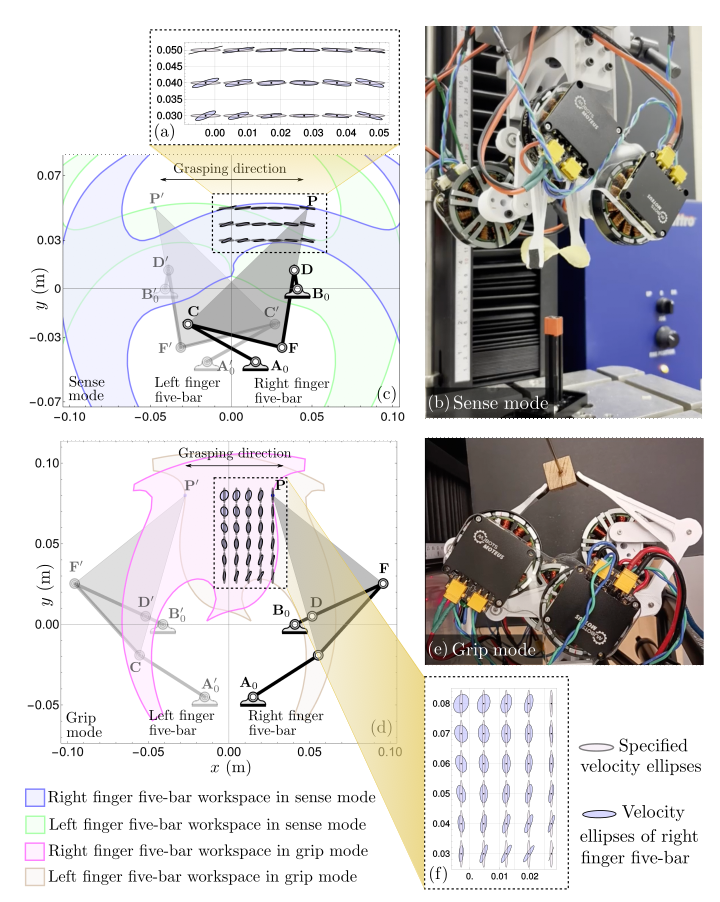
Our Solution: Each gripper finger is a five-bar mechanism that has multiple configurations for the same fingertip position. The Jacobian (force transmission) changes depending on the configuration and hence, there exists a selection of Jacobians for the same fingertip position. We propose switching between these configurations to achieve both high force sensitivity, in sense mode, and high force production, in grip mode.
2. Computational Design
The five-bar link lengths are optimized to achieve contrasting force transmission property across two different output modes (or, in our case, inverse kinematic branches). The problem was framed as velocity ellipse synthesis over multiple output modes. Velocity ellipses with major axes along the gripping direction are specified for the sense mode to achieve high force sensitivity. For grip mode, velocity ellipses with minor axes along the gripper direction are specified to maximize mechanical advantange and force production.
- Five-Bar Mechanism: Chosen for its parallel structure and multiple distinct workspace configurations for the same end point (fingertip position).
- Optimal Synthesis: We pose the ellipse synthesis problem as an optimization problem where optimal five-bar link lengths are computed to achieve the specified ellipses across the sense and grip modes.
- Algorithm: Multiple five-bar link lengths are randomly seeded and optimized using interior point optimization method to find multiple optimal five-bar design. The one that best approximates the specified ellipses while meeting the practical design constraints is chosen for fabrication.
3. Mechanical Design & CAD
Translating the mathematical synthesis into a physical prototype required strict attention to structural stiffness, ensuring that physical deflection didn't affect the proprioceptive current readings.
Double Shear Joints
Utilized double shear joints across the mechanism to drastically improve joint stiffness and eliminate out-of-plane twisting during high-force grasping.
Optimized Link Profiles
Engineered linkages with Half-I and I-shaped cross-sections. This maximizes area moment of inertia while minimizing rotating mass.
Compact Packaging
Assembled the links of each five-bar in parallel planes while assembling links of the other five-bar in the same plane
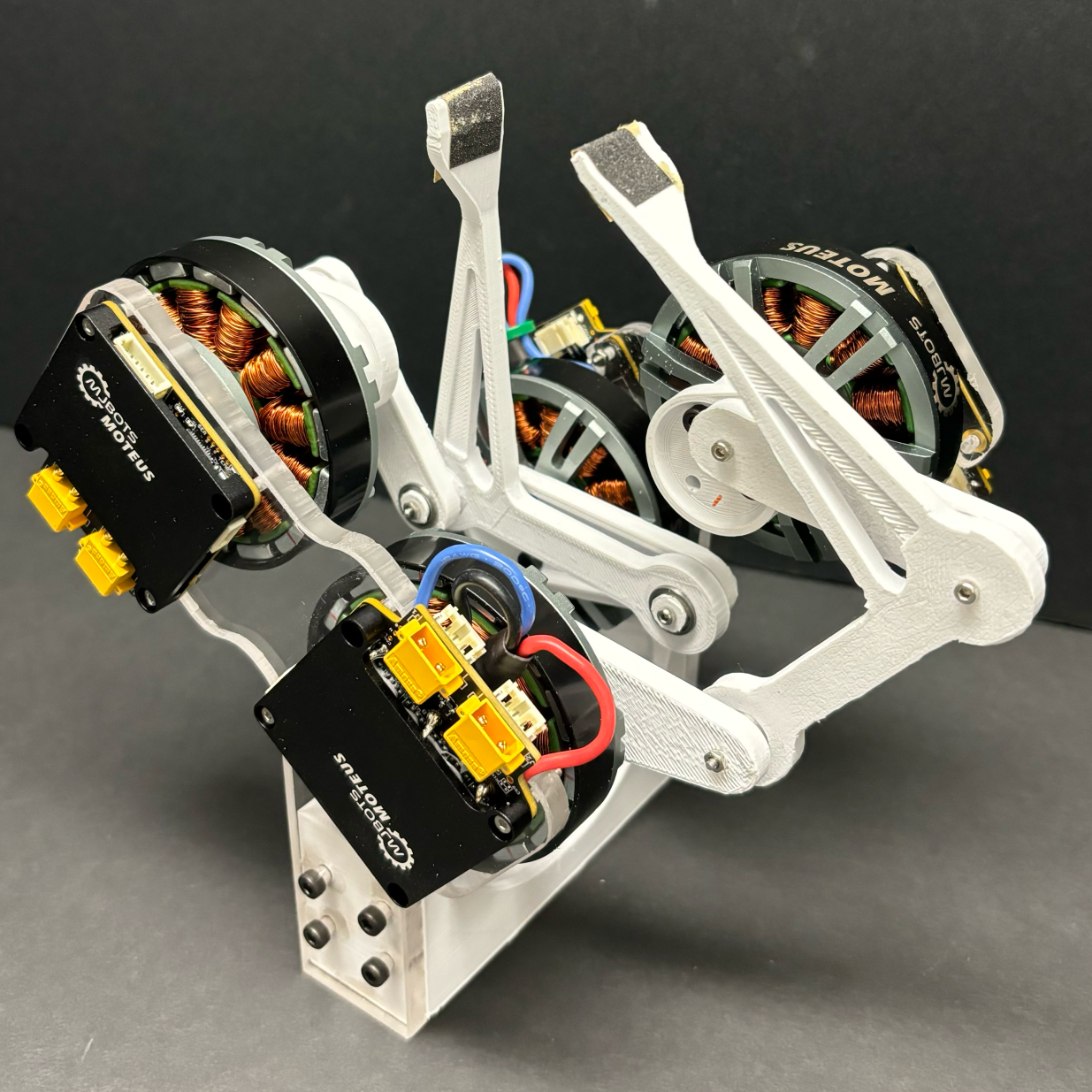
Physical Prototype
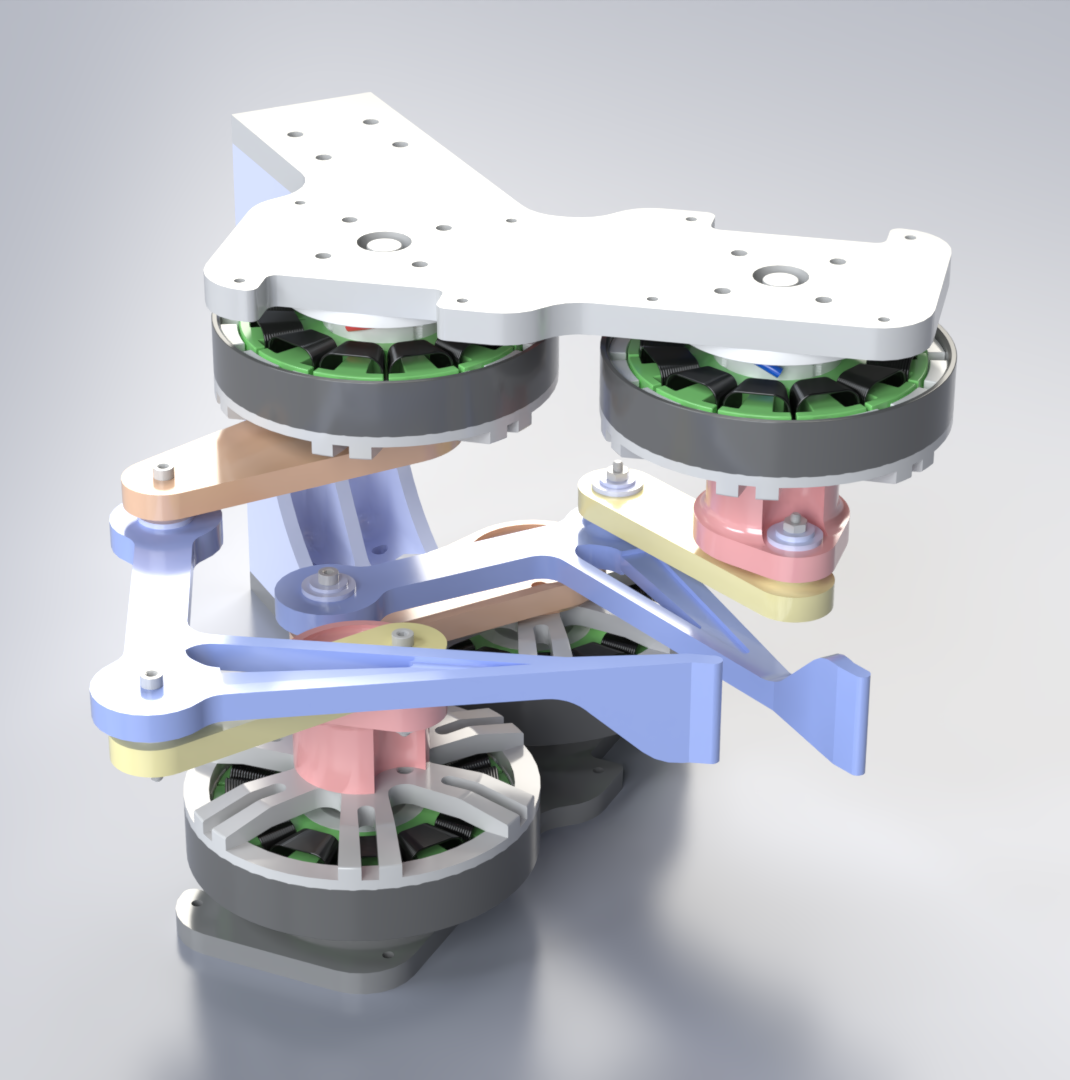
SolidWorks CAD Render
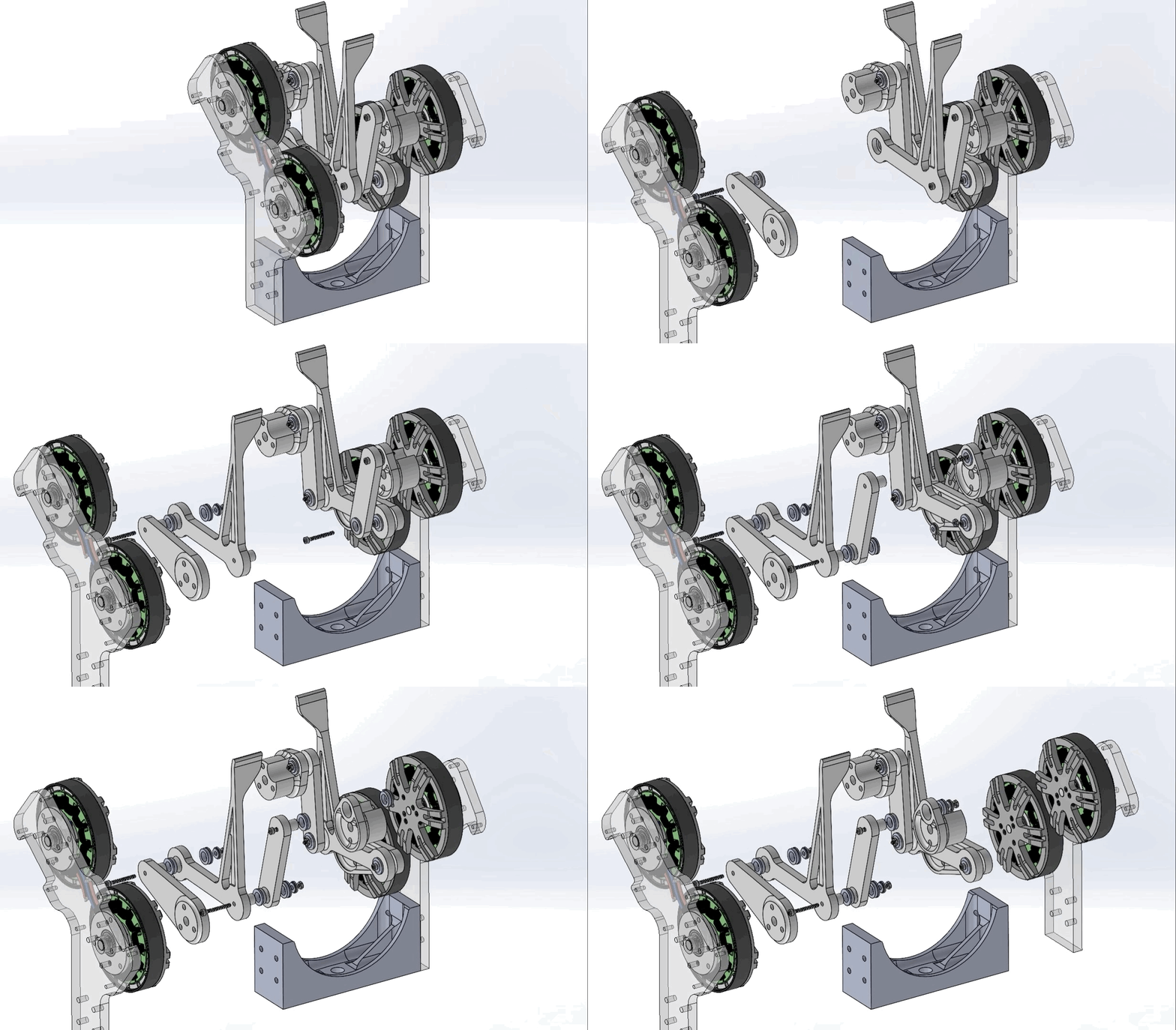
Exploded Assembly Flow
4. Fabrication
The physical realization of the gripper involved rapid prototyping and precise machining.
- Material Selection: Polyactic acid (PLA) plastic for rigidity and ease of 3D printing
- Machining: Laser cutting was used to precisely cut acrylic plastic sheets for motor mounts.
- Actuation: 330 Kv Brushless DC motors (BLDC) with BLDC motor drivers with FOC control from mjbots
- Assembly: Tolerances for bearing fits and shafts needed multiple iterations of 3D printing, particularly for the double shear joints, to minimize play and improve joint stiffness
5. Experimental Validation
To validate the synthesis model, the gripper was tested under real-world conditions. We successfully demonstrated its ability to detect forces as low as 100 g in Sense Mode and grasp with up to 1.5 kg force in Grip Mode.
Experiment 1: Practical Application
Demonstration of sense and grip modes for handling delicate and heavy objects.
Experiment 2: High force sensitivity in sense mode
Sense mode can sense forces 3x smaller than grip mode
Experiment 3: High force production in grip mode
Grip mode can exert forces 4x greater than sense mode
Experiment 4: Caveats of sense and grip modes
Mode switching is necessary since sense mode cannot grasp heavy objects and grip modes fails to detect contacts