1. The Problem: Limited Torque Output of Direct-Drive Motors
Direct-drive brushless motors offer high bandwidth and backdrivability while overcoming the disadvantages of gearboxes including friction, backlash and transmission losses. However, elimination of gears limits the force output of manipulators that use direct-drive actuators. In applications where manipulators have to carry heavy payloads against gravity at high speeds along the horizontal direction, simply using gears will diminish the speed or bandwidth of horizontal motion.
Our Solution: We bias the force and velocity transmission along different Cartesian directions of the end-effector. By shaping the velocity ellipses inside the workspace to have vertical minor axes, the vertical payload capacity is increased while achieving high velocities along the horizontal direciton.
2. Computational Design
The five-bar link lengths are optimized to achieve high force production at the end-effector along the vertical direction. By shaping the velocity ellipses to have vertical minor axes, high payload capacity is achieved. Such "flat" velocity ellipses are achieved by shaping the lower and upper workspace boundaries of the five-bar mechanism to be flat. The link lengths of the five-bar are optimized using root finding in Bertini software to achieve flat workspace boundaries. Further details on the five-bar synthesis can be found in the following conference paper.
S. Ramesh and M. Plecnik, "Synthesizing the Transmission Properties of a Five-Bar Linkage by Shaping Workspace Bounds," in Advances in Robot Kinematics 2024, Springer Proceedings in Advanced Robotics, vol 31, 2024.
doi: 10.1007/978-3-031-64057-5_213. Mechanical Design & CAD
Design of 3D printed links for the manipulators required attention to structural stiffness to withstand heavy payloads under dynamic conditions.
Double Shear Joints
Utilized double shear joints across the mechanism to drastically improve joint stiffness and eliminate out-of-plane twisting due to heavy payloads.
Optimized Link Profiles
Engineered linkages with Half-I and I-shaped cross-sections. This maximizes area moment of inertia while minimizing rotating mass.
Test Bench Setup
Assembled a test bench to experiment payload capacity and electrical power consumption under static and dynamic loading
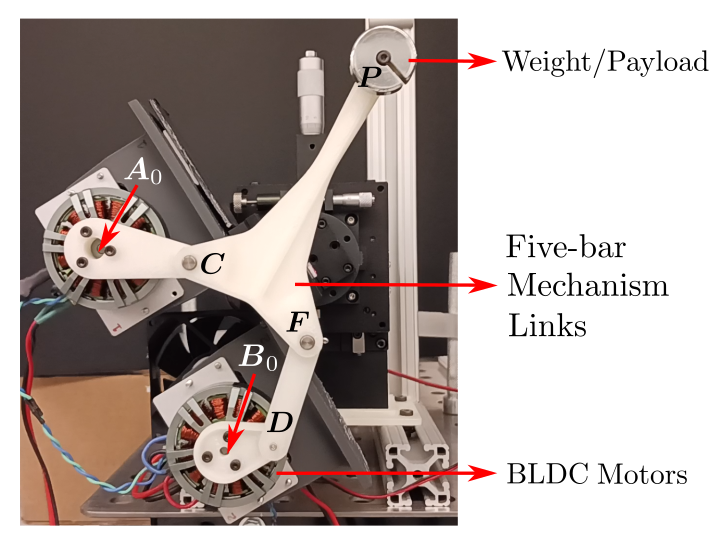
High Payload Manipulator Prototype
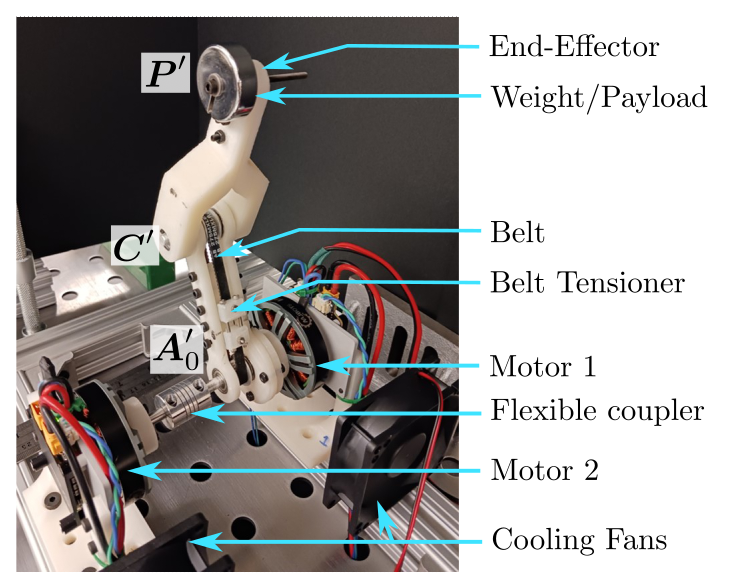
Conventional 2R Manipulator Prototype
Test Bench to Compare Performance (conventional 2R on the left and HPM on the right)
4. Fabrication
The prototyping involved the construction of the test bench, five-bar and 2R manipulators.
- Material Selection: Polyactic acid (PLA) plastic for rigidity and ease of 3D printing
- User Interface for Data Logging: Python based GUI to log motor positions and power consumption during experiments
- Actuation: 330 Kv Brushless DC motors (BLDC) with BLDC motor drivers with FOC control from mjbots
- Assembly: Tolerances for bearing fits, timing belts and shafts needed multiple iterations of 3D printing, particularly for the double shear joints, to minimze play and improve joint stiffness
5. Experimental Validation
Rigorous experiments over 8 months were conducted to study the performance of the HPM in the real world. Its performance with respect to payload capacity, power consumption and position tracking under static and dynamic conditions was studied and compared with the conventional 2R manipulator, also fabricated and experimented in practice. The videos below summarizes the key results while the paper documents all the experiments performed.
Experiment 1: Drawing Velocity Ellipses
Commanding small sinusoidal signals to the motors results in the end point tracing the velocity ellipse
Experiment 2: Static Power Consumption
The five-bar consumes up to 8x lower power compared to the conventional 2R manipulator
Experiment 3: Maximum Load Capacity
The five-bar shows 3.75x increase in payload capacity
Experiment 4: Dynamic Power Consumption
The five-bar exhibits 3.7x lower power consumption and 2x increase in tracking accuracy