1. The Challenge: Simple Gripper Design for Grasping and Propreoceptive Sensing of Delicate Objects
In addition to securely handling objects, grippers endowed with a sense of touch are desirable for handling delicate objects. Force sensors can be mounted distally at the fingertips, but a simpler option is to estimate fingertip forces from motor current at the base. This approach, which is not new, reduces wire routing and recesses electronics away from the sensed surface for operation in wet environments. However, for such a strategy to work, the actuating motor must have no or low gearing, which increases its transparency to external torques, but greatly limits its own torque output. Therein lies a trade-off.
Our Solution: A simple compliant mechanism for the gripper finger that can reconfigure between sense mode, biased for force sensing, and grip mode, biased for force production. The gripper uses a single direct-drive motor to sense, grasp and reconfigure between the modes.
2. Computational Design of Gripper Finger
The gripper design is kept simple by using a single moving finger to grasp objects against a rigid finger. The moving finger uses a six-bar linkage mechanism to transmit actuator motions to the fingertip. The six-bar has a special architecture with a Grashof and parallelogram four-bars. The crank attaches to the motor and the coupler of the parallelogram is rigidly connected to the fingertip. The gripper finger mechanism is fabricated as a compliant mechanism to reduce component count, ease manufacturing and improve reliability.
- Grashof Four-bar: Allows for complete rotations of the crank. Its transmission ratio is tuned to achieve low mechanical advantage (high sensitivity) and high mechanical advantage (high grip force) in the sense mode and grip mode which are across the output singularity.
- Parallelogram Four-bar: Keeps the fingertip at a constant orientation to ease grasping of objects.
- Sense and grip force: The low mechanical advantage in the sense mode allows for amplifying small fingertip forces to detectable actuator torques. In contrast, the grip mode amplifies actuator torques to high grip forces.
3. Mechanical Design & CAD
Majority of the six-bar finger mechanism is designed as a monolithic compliant mechanism to eliminate joints, backlash and reduce the component count, thereby making the design simple and reliable.
Monolithic Finger Design
The compliant gripper finger is design to be manufactured as a single piece which reduces cost and complexity
Flexure Hinges
The compliant gripper finger uses flexures that can undergo large deformations and approximate a hinge joint
Single Driver Link
Designed with exactly one traditional physical pin joint at the actuator drive crank to allow multiple actuator rotations.
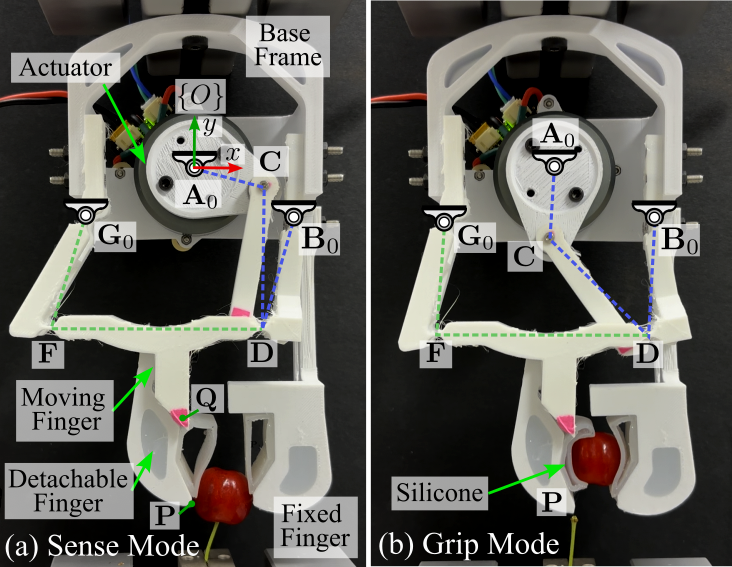
Simple Compliant Gripper Prototype in Sense and Grip Modes
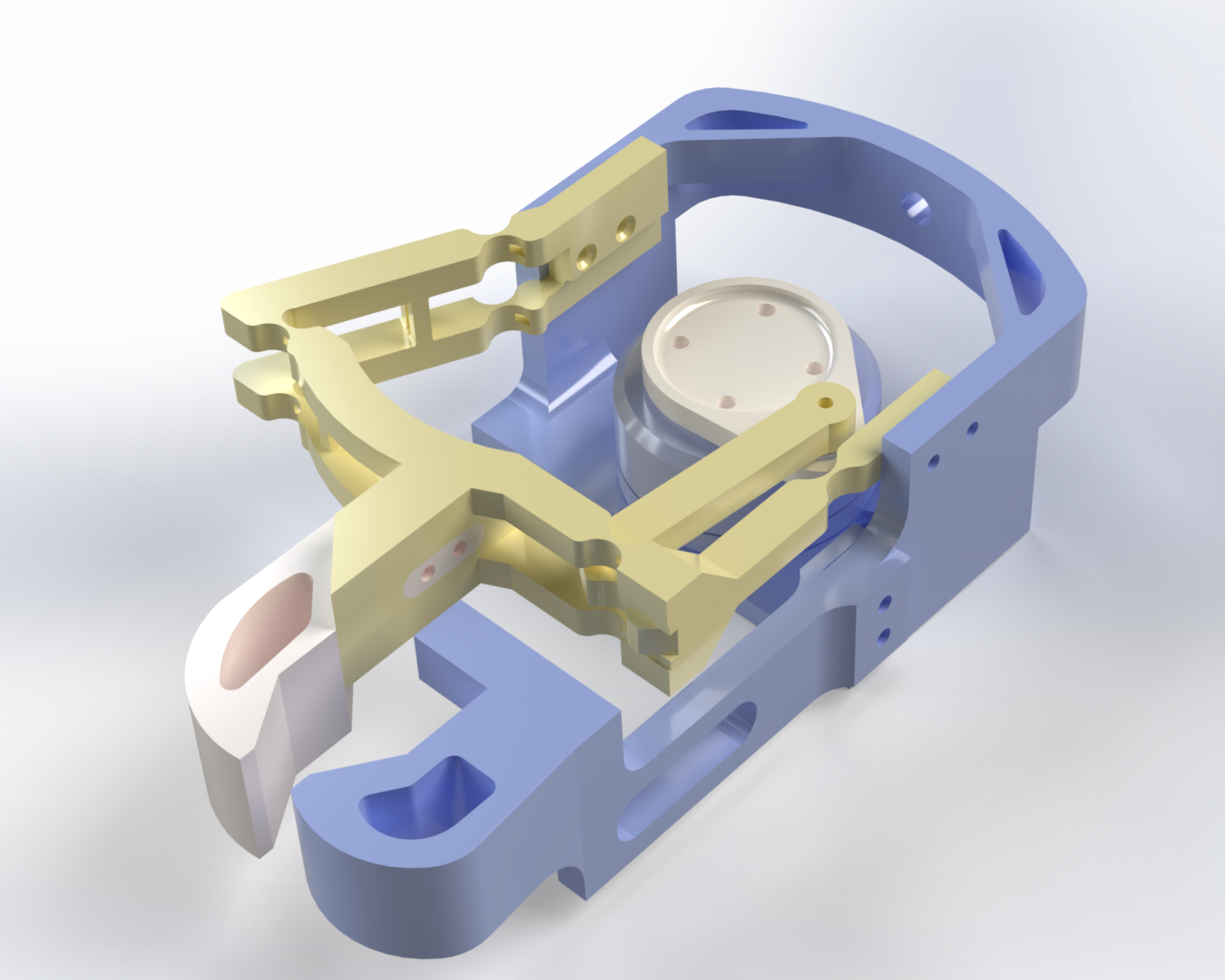
SolidWorks CAD Render
Exploded View of the Gripper Prototype
4. Fabrication
The compliant finger is fabricated as a monolithic part to reduce manufacturing cost and improve reliability by reducing component count.
- Material Selection: Thermoplastic Polyurethane (TPU) plastic for the compliant finger and PLA plastic for the rigid base
- Flexure Stiffness Tuning: Thickness and width of flexures were tuned to reduce stiffness while meeting strength and 3D printing constraints (e.g. 0.8 mm minimum thickness)
- Actuation: 210 Kv Gimbal motors (GL40) from CubeMars and BLDC motor drivers with FOC control from mjbots
- Sensing and Control using C++: C++ code for up to 1kHz position control frequency ensures rapid contact sensing, object stiffness estimation and high force grasping
5. Experiments
Elaborate experiments were performed to measure the minimum sense force, maximum grip force and stiffness estimation of objects including small fruits to estimate their ripeness. Complete videos can be found in the supplementary section in the published article.
Experiment 1: Ripeness Estimation and Fruit Picking
In the sense mode, the motor current feedback is used to sense contact and estimate fruit stiffness from which ripeness is estimated. The grip mode is used to grasp and pluck the fruit.
Experiment 2: Verification of Kinematics
The path of the fingertip resulting from the motor's rotation is compared with the predictions from kinematics.
Experiment 3: Sense and Grasp Forces
The sense mode can measure 2.6x smaller forces and grip mode can apply 3.1x more force.
Experiment 4: Stiffness Estimation of Objects
Sense mode is well suited for estimating stiffness of objects having less than 150 N/m stiffness without excessively deforming it